
News · October 07, 2026, 05:46 UTC · Verified against the sources listed below.
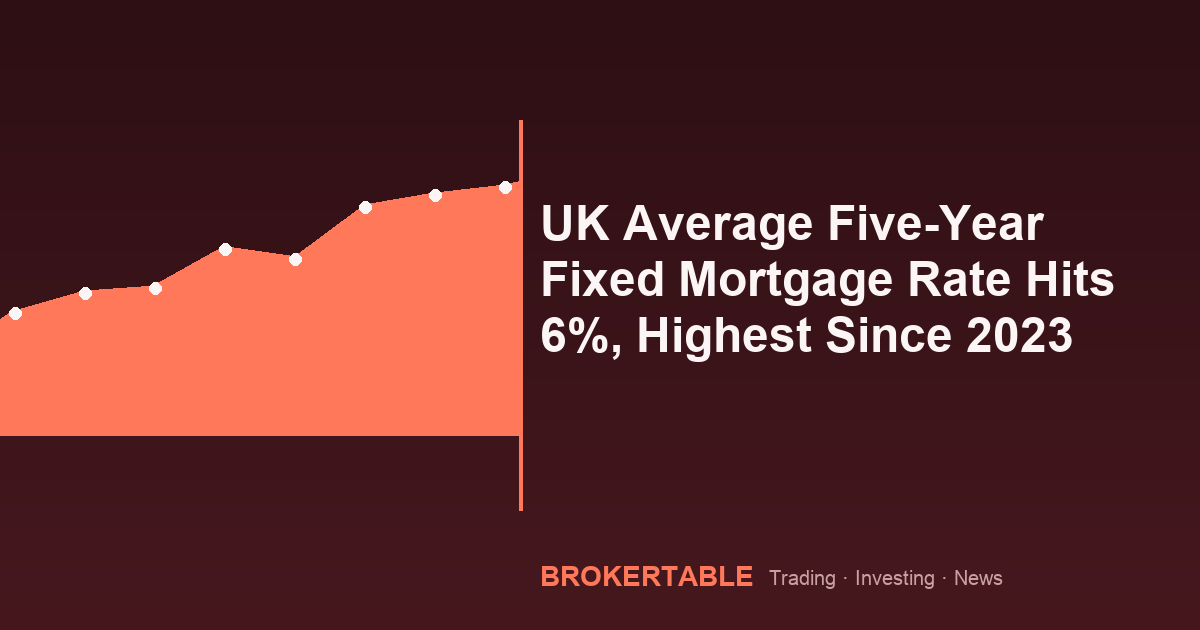
The average cost of a five-year fixed-rate mortgage in the United Kingdom reached 6.00% on October 5, 2026, according to data from the financial information service Moneyfacts. This is the first time the benchmark has hit that level in three years, specifically since September 2023.
The average two-year fixed rate was close behind at 5.98%, its highest point since December 2023. The figures were published as lenders continued to reprice home loans amid volatility in global bond markets.
What happened
Moneyfacts reported that the average five-year fixed mortgage rate climbed to 6.00% as of October 5, 2026, while the average two-year fixed rate stood at 5.98% on the same date. Both levels represent three-year highs for their respective products.
The number of fixed-rate mortgage deals priced below 5% collapsed by 99% since the start of September 2026. According to Moneyfacts, there were 1,494 such deals at the beginning of September, but only nine remained by October 5.
Major High Street lenders made repeated increases to selected fixed rates during September. Barclays raised selected fixed rates on four occasions, while HSBC, Lloyds Bank, Nationwide, NatWest, Santander and TSB each made three rounds of increases, Moneyfacts said.
Rachel Springall, a finance expert at Moneyfacts, described the situation as “brutal” for borrowers. “Average fixed mortgage rates rising back to three-year highs will be disastrous news for borrowers,” Springall said. “Borrowers who were hoping mortgage rates would stabilize will be disappointed.”
The repricing has been driven by rising gilt yields and swap rates, which serve as benchmarks for fixed-rate mortgage pricing. Although the Bank of England has left its base rate unchanged at 3.75% since December last year, volatility in bond markets has increased expectations of a future rate rise.
Analysis: Why it matters for investors
The move above 6% on five-year fixes is a key threshold for UK housing affordability. Higher mortgage costs reduce the borrowing capacity of prospective buyers and increase monthly payments for homeowners refinancing existing loans.
Figures from the HomeOwners Alliance, cited by The Guardian, show the monthly cost of a £250,000 loan fixed at 6% for five years is £158 higher than the same-sized loan locked in at 4.94%. That lower rate was the average reported by Moneyfacts at the start of February 2026, before the Iran war began.
There are already signs that higher mortgage costs are weighing on the housing market. Nationwide Building Society reported last week that annual house price growth halved in September. Ian Harris, president of the estate agents’ body NAEA Propertymark, said members were “seeing firsthand how sensitive buyers are to mortgage rates.”
For investors in UK banks and mortgage lenders, the repricing reflects higher wholesale funding costs rather than expanding net interest margins. Lenders face pressure from rising gilt yields, which increase their own borrowing costs. The Bank of England’s Decision Makers’ Panel showed one-year-ahead inflation expectations increased to 3.3% in September from 3.1% in August.
Interest rate-setter Dave Ramsden said last week that inflation risks have “tilted more to the upside” since the Bank’s last decision in September. He added that if “upside pressures on the inflation outlook continue to build, there could be a case for increasing Bank Rate.”
Who is affected
Homebuyers and anyone renewing a fixed deal are directly exposed to the higher rates. Just over five million homeowners should expect their monthly mortgage repayments to increase by the end of 2028, according to Bank of England forecasts cited by the BBC.
Borrowers coming to the end of fixed deals face the most immediate pressure. Springall said those borrowers would be “wise to seek advice and compare deals carefully.” Some lenders allow customers to lock in a rate three months before their current deal ends, while others allow six months.
The number of sub-5% variable-rate mortgages has remained broadly stable, according to Springall. This has led some borrowers to choose deals that track the Bank of England base rate instead of fixing.
Wider consumer spending is also affected. The BBC reported that drivers saw the average cost of diesel rise above £2 a litre in the UK for the first time on Friday, according to the RAC motoring group. Domestic energy prices rose by 4% at the start of October, and forecasters have predicted a 16% increase when regulator Ofgem sets its next price cap for January.
What is still uncertain
The sources do not say whether the Bank of England will raise its base rate at its next meeting. While Ramsden indicated a hike could be justified if inflation pressures build, the central bank has not announced any change to its current 3.75% rate.
The trajectory of global bond markets and the Iran war’s economic impact remain uncertain. These factors will influence whether fixed mortgage rates continue to rise or stabilize in the coming weeks.
Conclusion: What to watch next
The UK government is under pressure to support households struggling with higher costs at the Budget later this month. Any fiscal measures could affect gilt yields and, in turn, mortgage pricing.
Investors should monitor the Bank of England’s next rate decision and any signals from rate-setters about the inflation outlook. The number of sub-5% fixed deals remaining in the market will also indicate whether lenders expect funding costs to ease or remain elevated.
Sources
- bbc.com: Average five-year mortgage rate hits 6% for first time in three years (published 2026-10-05)
- the Guardian: Average five-year fixed mortgage rate hits 6% for first time in three years (published 2026-10-05)
- City AM: Average five-year fixed mortgage rate surges past six per cent (published 2026-10-05)
Sources accessed on October 07, 2026. Figures as reported by the sources above.
Frequently Asked Questions
What is the current average five-year fixed mortgage rate in the UK?
The average five-year fixed mortgage rate reached 6.00% on October 5, 2026, according to Moneyfacts. This is the highest level since September 2023.
How many mortgage deals below 5% are still available?
According to Moneyfacts, only nine fixed-rate mortgage deals priced below 5% remained as of October 5, 2026. This represents a 99% decline from 1,494 deals at the start of September 2026.
Why are mortgage rates rising?
Mortgage rates are rising because lenders' wholesale funding costs have climbed due to rising gilt yields and swap rates. Global economic uncertainty following the Iran war has also pushed up the cost of deals.
How much more do borrowers pay at 6% compared to earlier rates?
Figures from the HomeOwners Alliance show the monthly cost of a £250,000 loan fixed at 6% for five years is £158 higher than the same loan at 4.94%, which was the average rate at the start of February 2026.
Has the Bank of England changed its base rate?
No. The Bank of England has left its base rate unchanged at 3.75% since December last year. However, volatility in bond markets has increased expectations of a future rate rise.
AI Notice: This article was created wholly or predominantly with the assistance of artificial intelligence and was published without human editorial review.
This article is for general information only and does not constitute investment advice. Always do your own research before making trading decisions.