News · October 01, 2026, 18:02 UTC
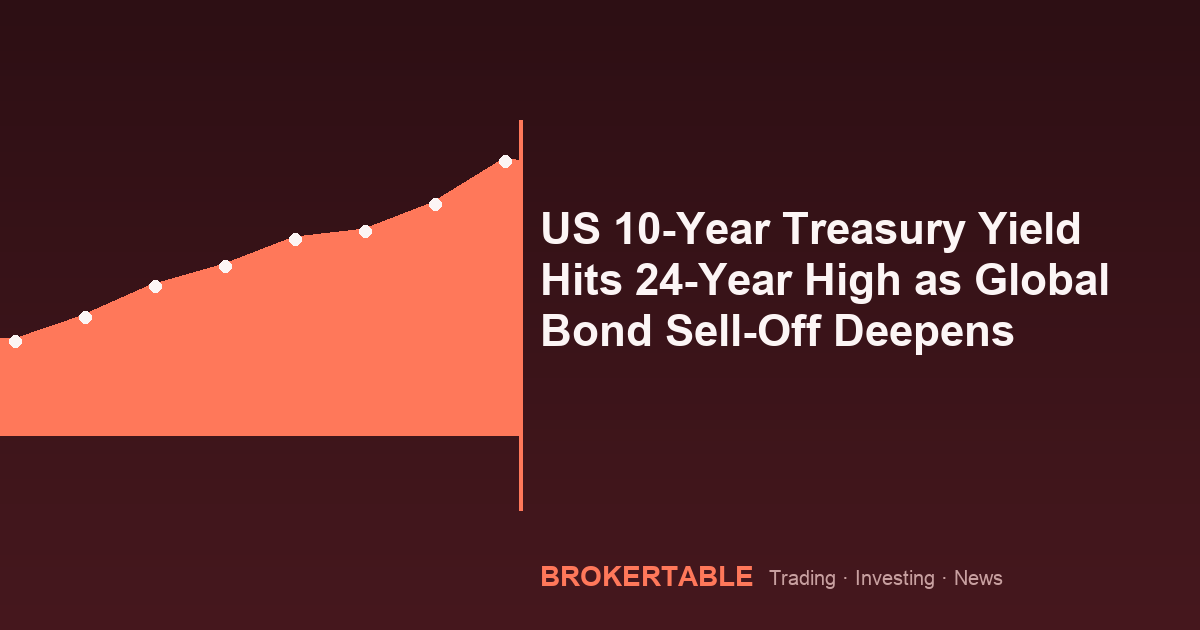
The yield on the 10-year US Treasury climbed to 5.34% on Thursday, October 1, 2026, its highest level in 24 years, as a global bond sell-off intensified. The benchmark yield later eased more than 4 basis points to 5.251% after breaching a level last seen in April 2002.
The move came as investors weighed persistent inflation, rising oil prices and heavy government borrowing ahead of upcoming US jobs data. The full original market data was not available; some details remain unconfirmed.
What happened
The sell-off was global. UK 30-year bond yields briefly rose above 6% for the first time since 1998 before easing, while five- and 10-year UK yields also rose.
Japan’s 10-year yield traded at 3.126%, its highest since the mid-1990s, and Germany’s 10-year bund topped 3.6%, the highest since 2008, before pulling back to 3.58%.
In the US, the 30-year Treasury yield also hit a 24-year high before retreating to 5.61%. The 10-year spiked as high as 5.33% and the 30-year touched 5.64% on Thursday.
Equities weakened alongside bonds. The FTSE 100 fell almost 1.7% in London, its worst daily drop since May, while Germany’s DAX lost 1% and France’s CAC 40 fell 1.6%.
US stocks remain close to record highs, with the S&P 500 up nearly 12% year-to-date and about 2% below its August closing high of 7,798.99.
Oil stayed elevated. Brent crude was back above $100 a barrel on Thursday as the US-Israel war with Iran obstructed Middle East crude exports.
Analysis: Why it matters for investors
Higher long-term yields raise borrowing costs across mortgages, auto loans and credit card debt, since the 10-year Treasury is a benchmark for those rates. That can tighten financial conditions and pressure risk assets, though the outcome depends on whether inflation and oil prices stabilize.
Some analysts see the move as a signal about fiscal policy rather than pure inflation fear. Jefferies economist Mohit Kumar said that “inflation, deficit and issuance concerns continue to weigh on the bond market,” adding that a buyers’ strike is underway until stability returns.
The Institute of International Finance said major economies face “persistently large deficits and rising interest expenses.”
Others argue the rise partly reflects economic strength. Atlanta Fed GDPNow estimated third-quarter growth at 3.7%, up from 2.2% in the second quarter, and JPMorgan strategists said curve steepening suggests a strong growth read-through.
US Bank’s Rob Haworth said long-term inflation expectations remain anchored around 2%-3%.
Who is affected
Bondholders have taken losses as prices fall when yields rise. The Vanguard Total Bond Market ETF is down 5% for the year. Hedge funds have suffered in the latest sell-off and lack the risk appetite to fade the move, while real-money investors are waiting for stability.
Governments face higher funding costs. Surging UK borrowing costs are increasing pressure on Chancellor John Healey before his first budget later this month. Michael Schumacher, formerly of Wells Fargo, said he would be concerned about countries with poor structural dynamics, such as the UK.
Equity investors are watching the divergence between stocks and bonds. Mark Malek of Siebert Financial said the gap is “abnormal” and approaching “extreme” levels.
What is still uncertain
It is unclear whether yields will continue rising or stabilize. Jeff Kilburg of KKM Financial said he sees the 10-year yield returning to around 4.5%-4.75% if the US and Iran reach a deal to end the war, but warned that continued conflict would be problematic.
Nomi Prins of Prinsights Global said sovereign wealth funds and central banks are unlikely to step in as buyers. It has not been disclosed when the upcoming US jobs data will be released or what economists expect.
Conclusion: What to watch next
Investors will focus on the upcoming US employment report and any signals from the Federal Reserve about rate policy. Fed Chairman Kevin Warsh indicated at Jackson Hole that a rate hike was coming, and traders remain wary of a December increase.
Oil prices and Middle East developments will also shape inflation expectations. Central banks are expected to raise rates in the coming months to prevent price increases from becoming embedded.
Frequently Asked Questions
What was the 10-year US Treasury yield on October 1, 2026?
The 10-year US Treasury yield reached 5.34%, its highest level since 2002. It later eased more than 4 basis points to 5.251%.
Why did global bonds sell off?
The sell-off was driven by fears of renewed inflation from high oil prices, concerns about government deficits and heavy debt issuance, and expectations that central banks will raise interest rates.
How did UK bonds perform?
UK 30-year bond yields briefly rose above 6% for the first time since 1998 before easing slightly. UK 10-year yields increased 5 basis points to 5.483%.
How did stock markets react?
The FTSE 100 fell almost 1.7% in London, its worst daily drop since May, while Germany’s DAX lost 1% and France’s CAC 40 fell 1.6%. US stocks remained close to record highs.
What did analysts say about the bond market?
Jefferies economist Mohit Kumar cited inflation, deficit and issuance concerns plus a buyers’ strike. Mark Malek of Siebert Financial said the divergence between stocks and bonds is abnormal and approaching extreme levels.



AI Notice: This article was created wholly or predominantly with the assistance of artificial intelligence and was published without human editorial review.
This article is for general information only and does not constitute investment advice. Always do your own research before making trading decisions.