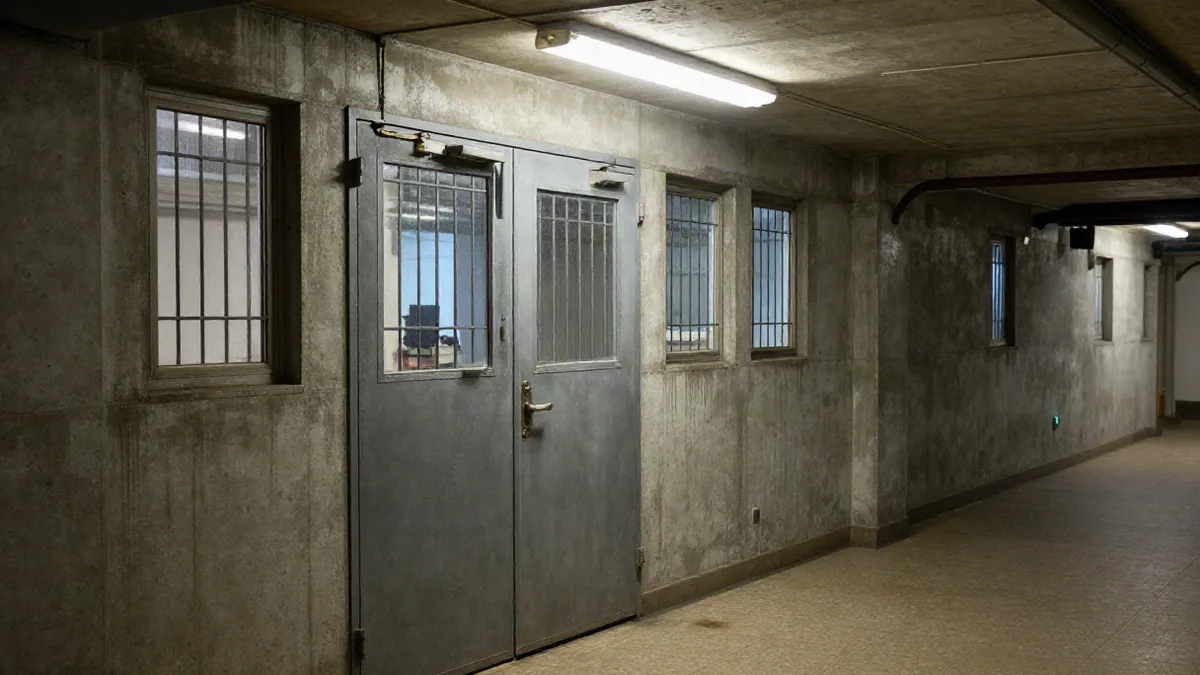
When you buy or sell a US stock through a broker, the trade often never reaches a public exchange like Nasdaq or the New York Stock Exchange. It gets filled inside a dark pool or another off-exchange venue.
These venues now handle a large share of US equity volume, and the exact share moves with market conditions.
A dark pool is a private trading system where orders are matched without displaying quotes to the public. The name describes the visibility, not the legality, because dark pools are registered with the SEC as alternative trading systems.
They are subject to rules, although those rules leave a lot invisible to you as an outside observer.
What a dark pool actually does
A dark pool is a matching engine run by a broker-dealer, a bank, or an exchange operator. Buyers and sellers submit orders to it, and the system crosses them internally at a price usually tied to the public market. Nobody sees the resting orders before a trade happens.
The core function is to let large orders trade without broadcasting intent. If a fund needs to sell a big block, a public limit order would signal supply and invite others to trade ahead of it. In a dark pool, that order can sit quietly and fill against a counterparty at a reference price.
Most dark pools price trades off the public midpoint or a volume-weighted average price, which means the execution is benchmarked to the lit market rather than discovered independently.
The public exchange still sets the reference price, while the dark pool mainly decides who gets filled and at what small adjustment.
This is why dark pools are best understood as a supplement to public markets, not a replacement. They borrow the price from the lit venues and add a private matching layer on top.
Who trades there and why
Institutional investors are the main users. Pension funds, asset managers, and hedge funds use dark pools to reduce market impact on large orders. A fund rebalancing a position worth many millions cannot dump it on an exchange without moving the price against itself.
Broker-dealers also route retail orders to dark pools and other off-exchange venues. Retail orders are usually small, and brokers often receive payment for order flow from wholesalers who execute them. The wholesaler may fill the order internally or route it to a dark pool.
Market makers use dark pools to manage inventory, so they can hedge or offset positions without showing their hand. High-frequency trading firms are present too, often providing liquidity and arbitraging small price differences between venues.
The mix matters, because a dark pool filled mostly with institutional block orders behaves differently from one dominated by market-maker flow. You usually cannot see which type you are trading against.
How a trade gets filled: a worked example
Suppose a mutual fund wants to sell 400,000 shares of a mid-cap stock. The public quote is 50.00 bid, 50.02 ask, with 3,000 shares on each side. Sending a 400,000-share market order to the exchange would sweep the book and push the price down sharply.
Instead, the fund’s broker splits the order, and part goes to a dark pool with a midpoint peg, where it rests at 50.01. When a counterparty buying in the same pool crosses against it, the first fill might be 60,000 shares at 50.01, with no public quote ever showing the fund’s supply.
The rest is worked over time across dark pools and lit venues, and each fill is small enough to avoid signaling. Although the fund accepts some price drift and pays a fee, the average execution may land far closer to the starting midpoint than a single large market order would have.
Now change one variable. If the dark pool has few natural sellers and mostly fast market makers, the fund’s resting bid may get picked off whenever the public price ticks down. The fund fills at 50.01 while the market drops to 49.90, and the midpoint peg turns into a small but repeated loss.
Same mechanism, different counterparty mix, different outcome.
What dark pools hide and what they reveal
Dark pools hide pre-trade information, so you cannot see resting orders, order sizes, or who is on the other side. That is the point of the design, and it is also the source of most suspicion.
They reveal post-trade information, but with a lag and in aggregate. Trades must be reported to the consolidated tape under FINRA rules, though reporting for off-exchange trades may be subject to different timing requirements.
The public sees that a trade happened and at what price, not the full context.
What you cannot easily see is the quality of execution inside the pool. Did your order fill at a fair midpoint, or did it fill just before the price moved against you? That requires analyzing your own fills against benchmarks, which most retail investors never do.

This asymmetry is the honest core of the debate. Dark pools are not secret in the sense of being unregulated. They are opaque in the sense that the information that would let you judge them is held by the venues and their participants.
The transparency rules that do exist
Alternative trading systems must register with the SEC and file Form ATS, and they must also make certain disclosures about their operations, subscribers, and order types. FINRA oversees them as broker-dealers and conducts examinations.
Regulation ATS, adopted by the SEC, reportedly added public disclosure requirements for ATSs that trade stocks. Venues must publish information about their operations and how they handle confidential trading interest.
The goal is to give the public and regulators a clearer picture of what happens inside.
There are also fair access rules, which reportedly mean a dark pool cannot arbitrarily exclude someone who meets its published criteria. Venues must protect confidential order information, and this is the legal backbone of the whole model.
The limits are real, because disclosure forms describe policies, not the daily reality of every fill. Regulators see more than you do, but enforcement is periodic, and problems can persist between examinations.
Myths worth retiring
Myth one: dark pools are illegal or unregulated. They are neither, because they are registered venues with rulebooks, examinations, and reporting duties. The legitimate criticism is therefore about opacity and conflicts, not legality.
Myth two: dark pools exist to cheat retail investors. Retail orders are usually small and may be executed by wholesalers, sometimes at prices at or better than the public quote. The bigger conflicts tend to involve order routing incentives and best-execution obligations, which apply across venues.
Myth three: dark pool trading causes crashes. While off-exchange venues can add complexity in stress and fragmented liquidity can worsen gaps, crashes have many causes. Blaming one venue type oversimplifies a system with many moving parts.
Myth four: all dark pool fills are bad. A midpoint fill with low market impact can be excellent for a large order, although the same fill can be poor if the price moves against you right after. Context decides.
Risks for short-term traders
If you trade over weeks to a few months, execution quality affects your returns more than you might think. A few cents per share on frequent trades adds up, and dark pool fills can be harder to evaluate than exchange fills.
Watch for partial fills, because a dark pool may fill only part of your order at a good price and leave the rest exposed to a worse market. Check whether your broker routes the remainder sensibly or lets it sit.
Watch for midpoint pegs in fast markets. When volatility spikes, a midpoint fill can look stale within seconds, so if you use market orders, you may get filled at a price that no longer reflects the book.
Watch for information leakage through your own behavior, because repeatedly sending similar orders to the same venue can let faster participants infer your pattern. Varying order types and venues is a practical defense, though it adds complexity.
Finally, understand your broker’s routing, because payment for order flow arrangements can create incentives that are not aligned with your best execution. Read the broker’s execution quality disclosures and compare fill prices against the public quote at the time you submitted.
Risks for long-term investors
If your horizon is six months or more, dark pool mechanics matter less to your individual fills and more to the market you own. Off-exchange trading affects price discovery, liquidity in stress, and the cost of trading when you or your fund rebalance.
One concern is that a large share of volume away from public exchanges can weaken the lit market’s depth. If public quotes thin out because orders are hidden elsewhere, the visible book may overstate fragility or understate true liquidity depending on the day.
Another concern is fund-level execution. Your mutual fund or ETF trades in dark pools on your behalf, and while better execution lowers costs, you cannot easily verify it. Ask whether your fund discloses execution quality or uses transaction cost analysis.
A third concern is market structure risk that shows up in crises. When liquidity evaporates, hidden venues may pull back, and the public market absorbs the pressure. That is a system-level risk you cannot diversify away by picking different stocks.
Edge cases that change the picture
Small-cap stocks behave differently. Because dark pools may have little natural flow in a thinly traded name, fills can be sporadic and pricing can drift from the public quote. A midpoint peg in an illiquid stock is a weaker promise than in a liquid one.
Opening and closing auctions are separate. Auctions on public exchanges concentrate liquidity and set official prices. Dark pool activity around the close can interact with auction dynamics in ways that affect your fill if you trade near the bell.
Corporate events create gaps. Around earnings or index rebalances, order flow surges and dark pool pricing can lag, so a fill that looked fair at submission may look poor minutes later.
Regulatory changes shift the ground. Because rules on disclosure, order handling, and best execution evolve, what was true about venue behavior a few years ago may not hold now. Treat any market structure description as time-stamped.
How to check your own executions
Start with your trade confirmations. Compare the fill price to the public bid and ask at the moment you submitted, and if your broker provides time-stamped quotes, use them. A pattern of fills worse than the midpoint deserves a question to your broker.
Look at fill sizes. Many small partial fills can mean your order was worked across venues, which is not automatically bad. What matters is whether the average price beat or lagged the benchmark you care about.
Review your broker’s execution quality reports, because US brokers publish statistics on routing and fill quality. The formats vary, but the direction of the numbers is informative when compared across brokers.
For fund investors, read the fund’s trading and execution disclosures. If transaction cost analysis is published, compare it to peers. If nothing is disclosed, that absence is itself information.
Conclusion: opacity is the point, and the price
Dark pools solve a real problem. Large orders need a place to trade without moving the market, and public exchanges alone cannot always provide that. The mechanism is simple: match privately, price off the public market, report after the fact.
The cost is opacity. You cannot see who is on the other side or whether your fill was fair without doing your own analysis. Regulators see more than you do, but disclosure rules describe policies more than daily practice.
For short-term traders, the practical work is checking fills, watching partial executions, and understanding routing incentives. For long-term investors, the work is at the fund and market-structure level, where hidden liquidity can affect stress behavior and rebalancing costs.
Treat dark pools as one layer of a fragmented market, not a villain or a savior. Judge them by the fills you can measure and the disclosures you can read. Where you cannot measure, size your exposure to that uncertainty accordingly.
- What Is Trading and How Does It Actually Work?
- Settlement Explained: What T+1 Means for Your Trades
- What is leverage and how does it work in stock trading?
Frequently Asked Questions
Are dark pools legal?
Yes. In the US they are registered with the SEC as alternative trading systems and overseen by FINRA as broker-dealers. The criticism is about opacity and conflicts of interest, not legality.
Do dark pools hurt retail investors?
Retail orders are usually small and often filled at or better than the public quote by wholesalers. The bigger issues are order routing incentives and best-execution obligations, which apply across venues, not only dark pools.
How can I tell if my trade went through a dark pool?
Your trade confirmation may show the venue or a code for off-exchange execution. Compare your fill price to the public bid and ask at submission time, and review your broker's execution quality reports for routing patterns.
Why do institutions use dark pools?
To trade large blocks without displaying intent and moving the public price against themselves. A midpoint fill in a dark pool can reduce market impact compared with a large order sent to a public exchange.
Do dark pools affect price discovery?
They can. Most dark pool trades are priced off the public market, but a large share of volume away from lit venues can thin visible depth and complicate liquidity in stress. The effect varies by stock and market conditions.


AI Notice: This article was created wholly or predominantly with the assistance of artificial intelligence and was published without human editorial review.
This article is for general information only and does not constitute investment advice. Always do your own research before making trading decisions.